
Zippy Klean is amazing! Truly the best service ever—so much attention to detail, not a single spot missed! The booking process was super easy, and their response time was lightning fast. I’m already looking forward to my next service. Highly recommend both the inside and outside detail packages!
Home › Motorcycle Detailing & Coating
More exposed metal. Less margin for error.
A bike has far more bare metal than a car and far less of it painted, so salt finds it first. Full detailing, chrome and stainless polishing, and permanent ceramic coating — with an honest conversation about what can and cannot be brought back.
Detail from $250
Borograph $650
Kona shop or mobile
Fully insured
Visual proof
Mostly done by hand, because it has to be
A bike is a hundred small surfaces and almost no flat panel. Spokes, fins, fasteners and the back of the swingarm are brush-and-towel work, not machine work, and the salt that collects in those places is exactly what you cannot see from the saddle.
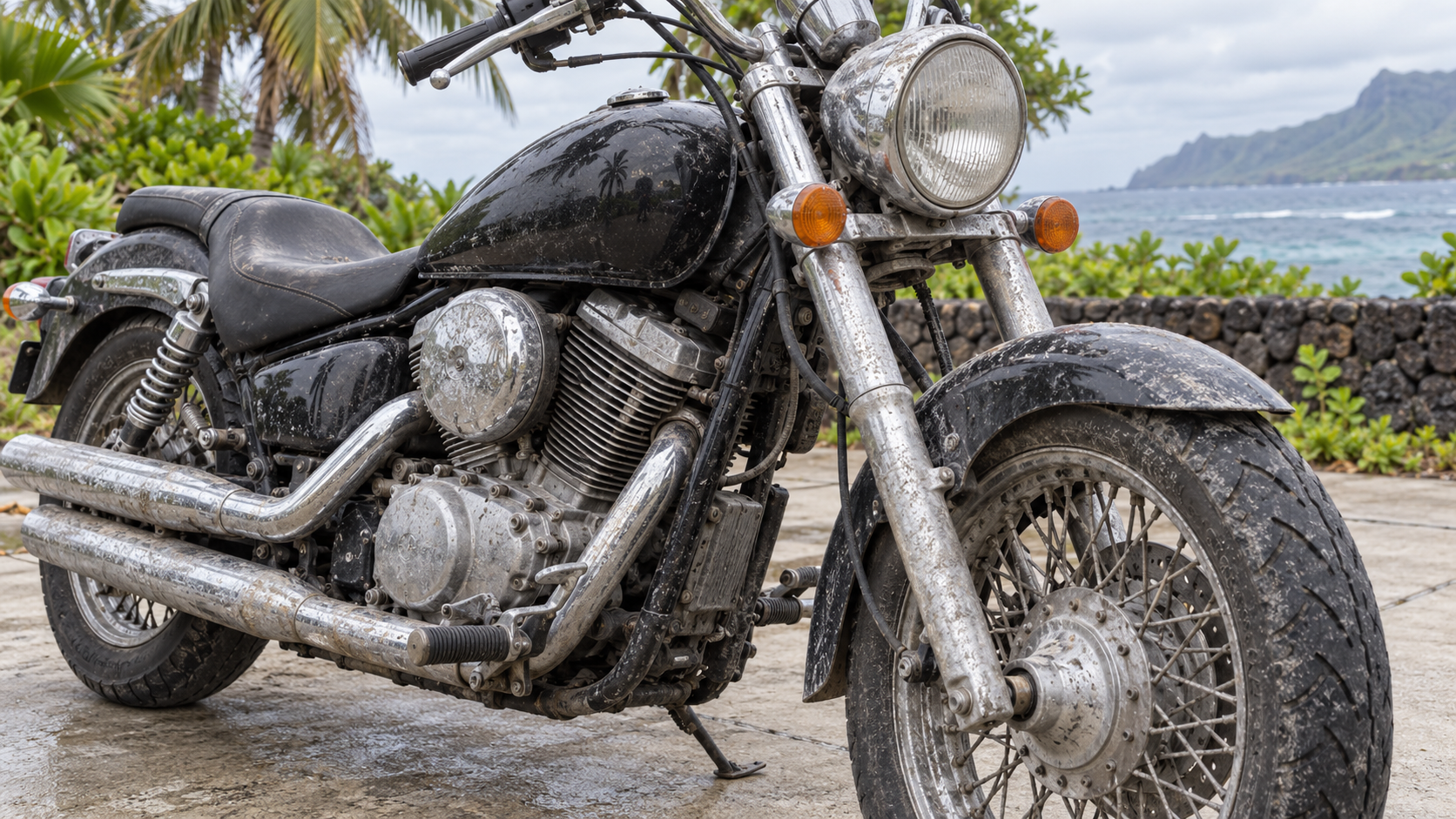
Before — salt haze on the chrome, film in the fins
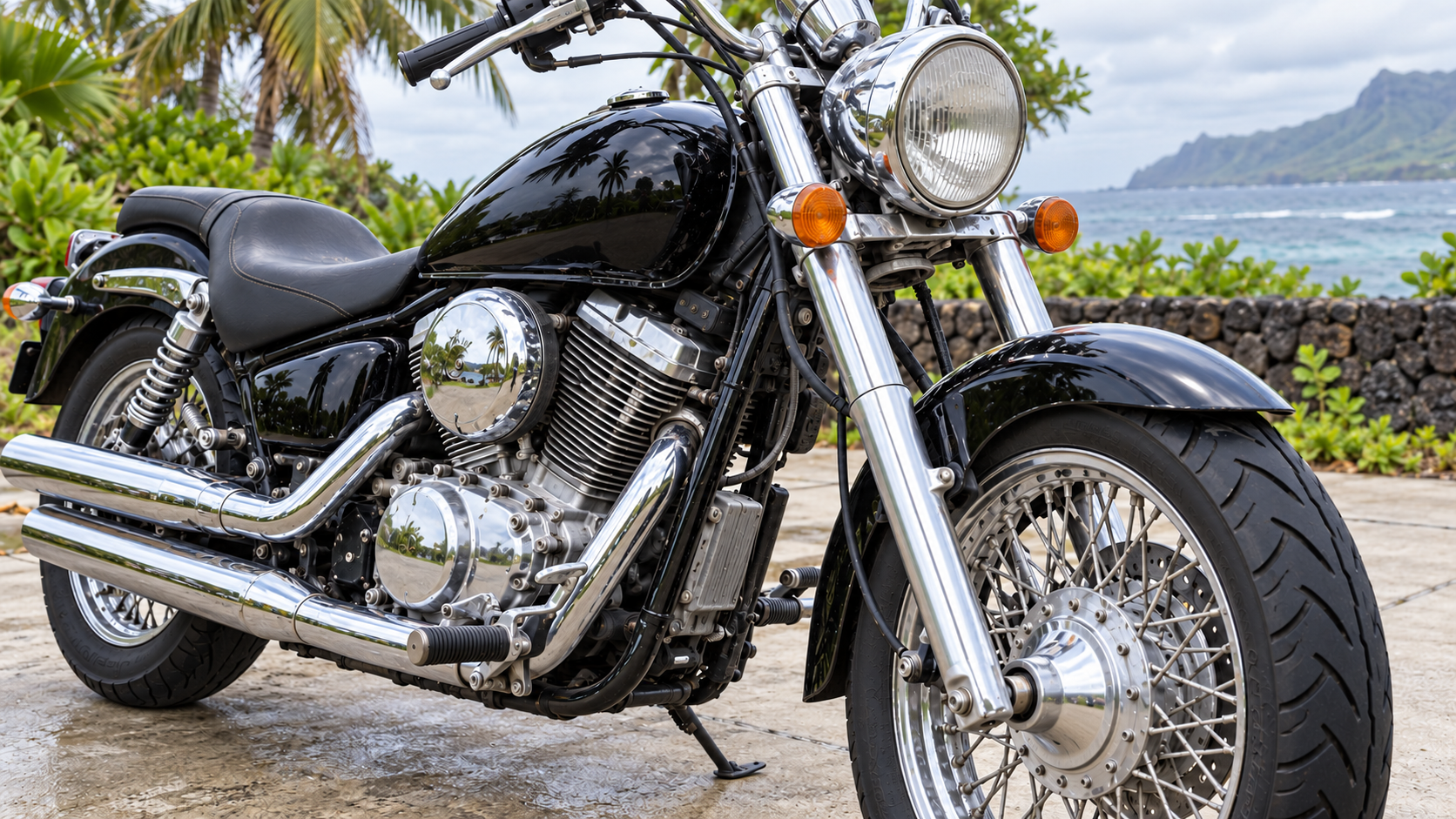
After — including everywhere a machine cannot reach
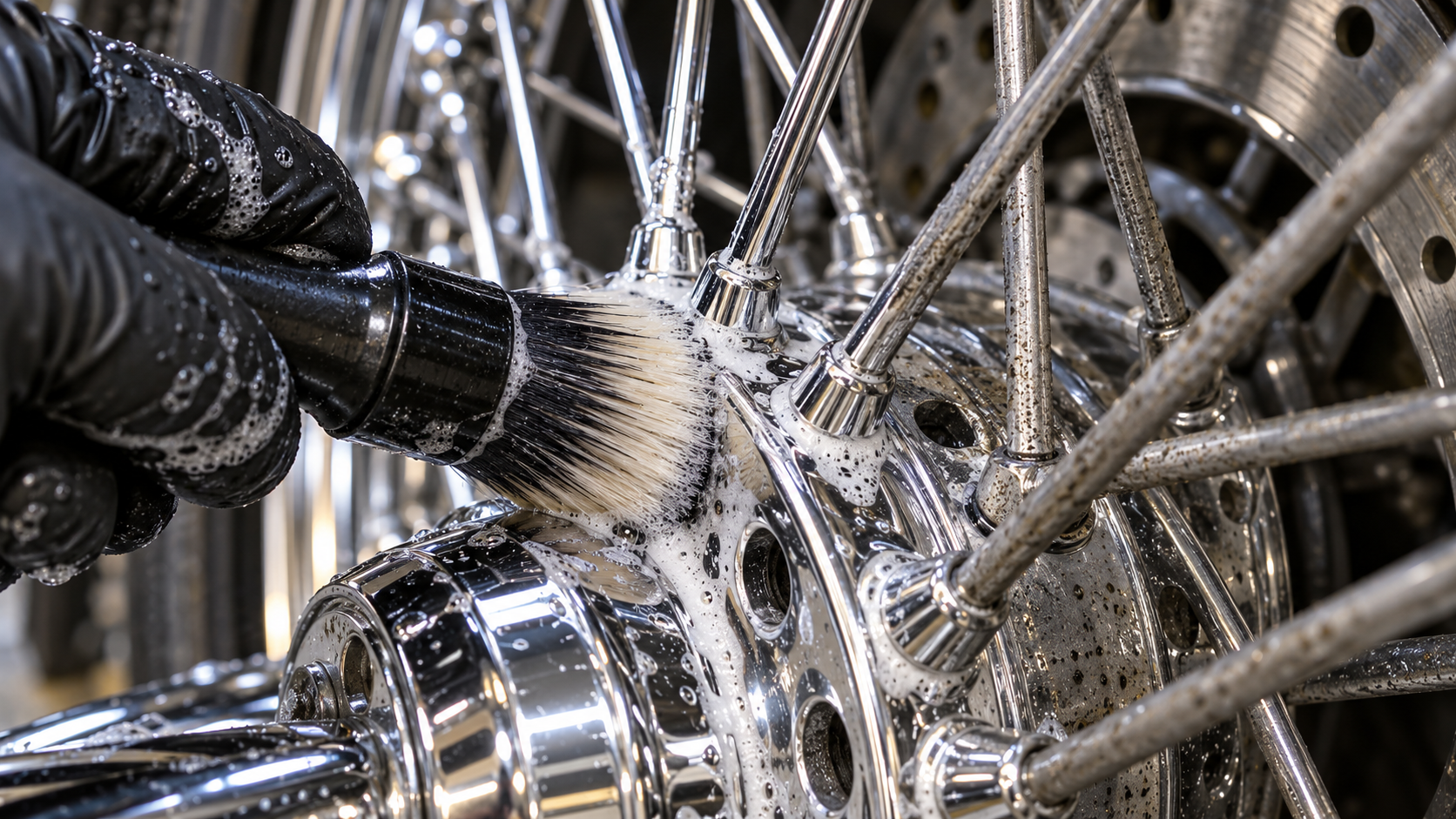
Spoke by spoke — there is no machine shortcut here
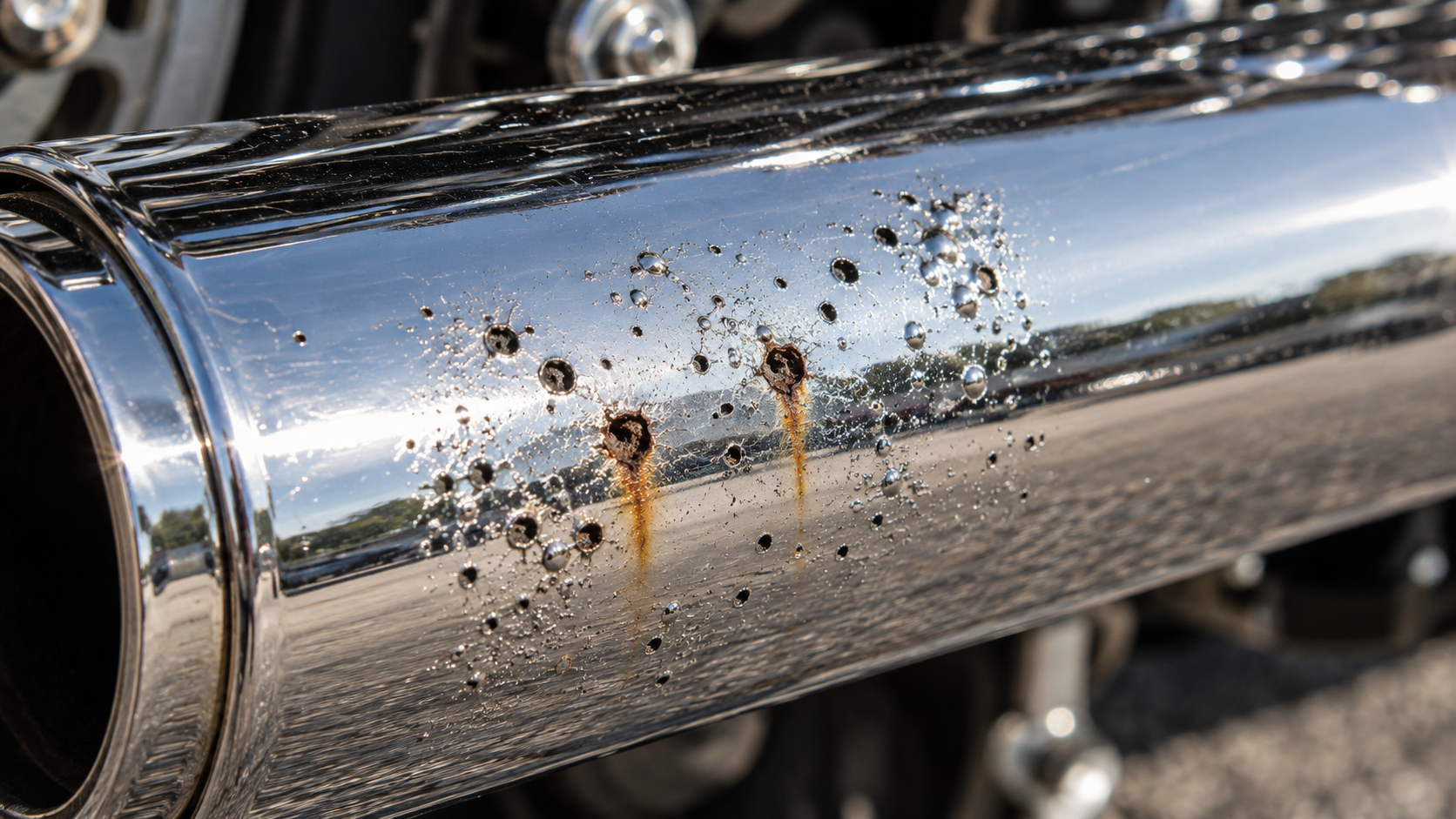
Pitted chrome means the plating is gone — shine cannot fill it
Tank to swingarm
What we do
Full hand wash & salt decon
Paint decontamination & clay
Machine polish — painted surfaces
Chrome & stainless polishing
Aluminium & cases
Leather & vinyl care
Ceramic coating
Liquid PPF + Borograph
What we do not coat: brake rotors, brake hardware, high-temperature exhaust surfaces, the seat, grips, pegs, or anything that needs friction to do its job. Coating a brake component is dangerous and no responsible shop does it. We walk the bike with you before we start and agree exactly what is in and what is out.
Said before you pay, not after
Two things we cannot fix
- Heat bluing on exhaust. It is a change in the metal itself, not a deposit on it. Nothing polishes it off. Some shops chemically treat it with limited and inconsistent results; we do not offer it. What we can do is polish the sound sections so the contrast is less obvious.
- Pitted chrome. Pitting is missing metal. Polishing gives you shiny pits. On this island it is common — salt gets under the chrome layer and lifts it from beneath, and once that has happened the plating is compromised. We will tell you which you have before quoting.
Bright, sound chrome polishes up dramatically and it is one of the most satisfying jobs we do. We would just rather you knew the difference before writing a cheque.
Island Special · Big Island pricing
What it costs
Prices shown are cash prices. Pay by cash or check and that is what you pay. The card price is shown in grey beside every figure — slightly higher, because card processing costs us that. Nothing is added at checkout either way: both prices are on the page before you book.
Hawaii GET is added at invoice and shown as its own line, at the state maximum visible pass-on of 4.712% (4% state + 0.5% Hawaiʻi County surcharge). Prices on this page do not include it.
Detailing & protection
Full motorcycle detail
$250$259 card
$75$78 card
Ceramic Infused Super ProtectionSix to twelve months on this island
$75$78 card
Permanent coating
Stealth Diamond Borograph CeramicPermanent, 10+ years, written warranty
$650$673 card
Liquid PPF + Stealth Diamond BorographAdds impact and abrasion resistance
$1,800$1,865 card
Quoted on inspection
Chrome & stainless polishingCondition range is enormous — a flat price would be a guess
Custom quote
Custom quote
Travel fee $50$52 card past 20 miles outside the Kona district. Gas on this island runs well above the mainland and the run to Waimea, Hawi or Hilo is real time in the truck — that fee goes straight to the technician working your job, not onto the service price. No fee if you drop off at our Kona shop near Magic Sands Beach Park — we give you the exact address when you book. We tell you the travel fee when you book, never when we arrive.
Fixed price, no surprises
13 years on the Big Island
5,000+ vehicles
Fully insured
Trained & certified techs
100% satisfaction guaranteed
In our customers’ words
Five stars, every one
Google Reviews
Shown word for word
Skyler with Zippy Klean did a very professional and fantastic job cleaning up my recently purchased 2023 Jeep Compass. Being a part time resident having the mobile service was critical for me!! I highly recommend Zippy Klean and Skyler for your automotive detail needs!! 👍🏻👍🏻
Above and beyond my expectations. My vehicle was in rough shape in the interior and they managed to restore to like new conditions like the day I bought it. Communicated effectively and very transparent. Will use again and highly recommend.
No obligation
Get your bike quoted
Send photos of the tank, the exhaust and any chrome you are worried about. We will tell you honestly what will come back and what will not.
Prefer to talk? (808) 201-6005 — call or text. Open 7 days · 6am–6pm.
Straight answers
Motorcycle questions
How much does motorcycle detailing and ceramic coating cost?
A full motorcycle detail is $250, Stealth Diamond Borograph ceramic is $650, and Liquid PPF with Borograph on top is $1,800.
Water spot removal and Ceramic Infused Super Protection are $75 each. Those are cash prices; the card price is shown beside every figure.
Chrome and stainless polishing and rust removal are quoted on inspection, because the condition range on bike brightwork is enormous and a flat price would be a guess.
Why does a bike cost less than a car to coat but take similar time?
Less surface, far more of it fiddly — the price reflects area, and the time reflects how much of that area has to be done by hand around parts that cannot be removed.
A fuel tank is quick. Everything around the engine, the frame rails, the swingarm and the brightwork is slow. It balances out to a price that is fair on both sides.
Can you remove heat bluing from my exhaust?
No. Heat bluing is a change in the metal itself, not a deposit on it — nothing polishes it off.
We would rather tell you this on the phone than after taking your money. What causes it is the metal oxidising at temperature, and the colour goes into the material. Some people chemically treat it with limited and inconsistent results; we do not offer it.
What we can do is polish the sound and unaffected sections to a high standard so the contrast is less obvious.
Can you polish pitted chrome?
No. Pitting is missing metal, and polishing makes it shinier and still pitted.
This is the other thing we say up front. On an island, pitting is common — salt gets under a chrome layer and lifts it from beneath, and once that has happened the chrome is compromised.
Polishing bright, sound chrome gives a genuinely dramatic result. Polishing pitted chrome gives you shiny pits. We will tell you which one you have before quoting.
Why do bikes corrode so badly here?
Marine salt is hygroscopic — it pulls moisture out of humid air, so dried salt on a bike keeps working on fasteners, spokes and chrome days after you rode.
A bike has far more exposed metal than a car and far less of it is painted, so it feels the effect much faster. Fasteners, spoke nipples, brake hardware and the backs of chrome pieces are where it starts.
Rinsing matters more here than almost anywhere, and a coating helps mainly by giving the salt a surface it cannot bond to so the rinse actually removes it.
Do you coat the frame and engine cases, or just the tank and fairings?
Painted and finished surfaces throughout — tank, fairings, fenders, frame and cases where the finish takes a coating properly.
What we do not coat: brake rotors, brake hardware, exhaust surfaces that reach high temperature, the seat, grips, pegs and anything that needs friction to work. Coating a brake component is dangerous and no responsible shop does it.
We will walk the bike with you before we start and agree exactly what is in and what is out.
Do you come to me?
Yes across West and North Hawaiʻi, or you can bring it to the Kona shop.
A bike is a good candidate for shop work because the fiddly brightwork is much easier under proper light. But mobile works fine if that suits you better.
East side is coatings only, mobile only — detailing and polishing stay West and North side.
Island Special · Big Island pricing
We take one coating a day
(808) 201-6005Kailua-Kona to Hilo. We come to you, or drop it at our Kona shop near Magic Sands. Book your spot.