
We had our 2023 Bronco Sport treated with the Borophene ceramic coating and it makes the car look brand new! We are fortunate to leave by the ocean, but that comes with the challenge of salt spray putting a film on the car. Looking forward to much easier maintenance and the car continuing to look great! Kelson did a super job and Steven was very helpful in providing information about the options and getting us scheduled.
Home › Aircraft & Helicopter Detailing
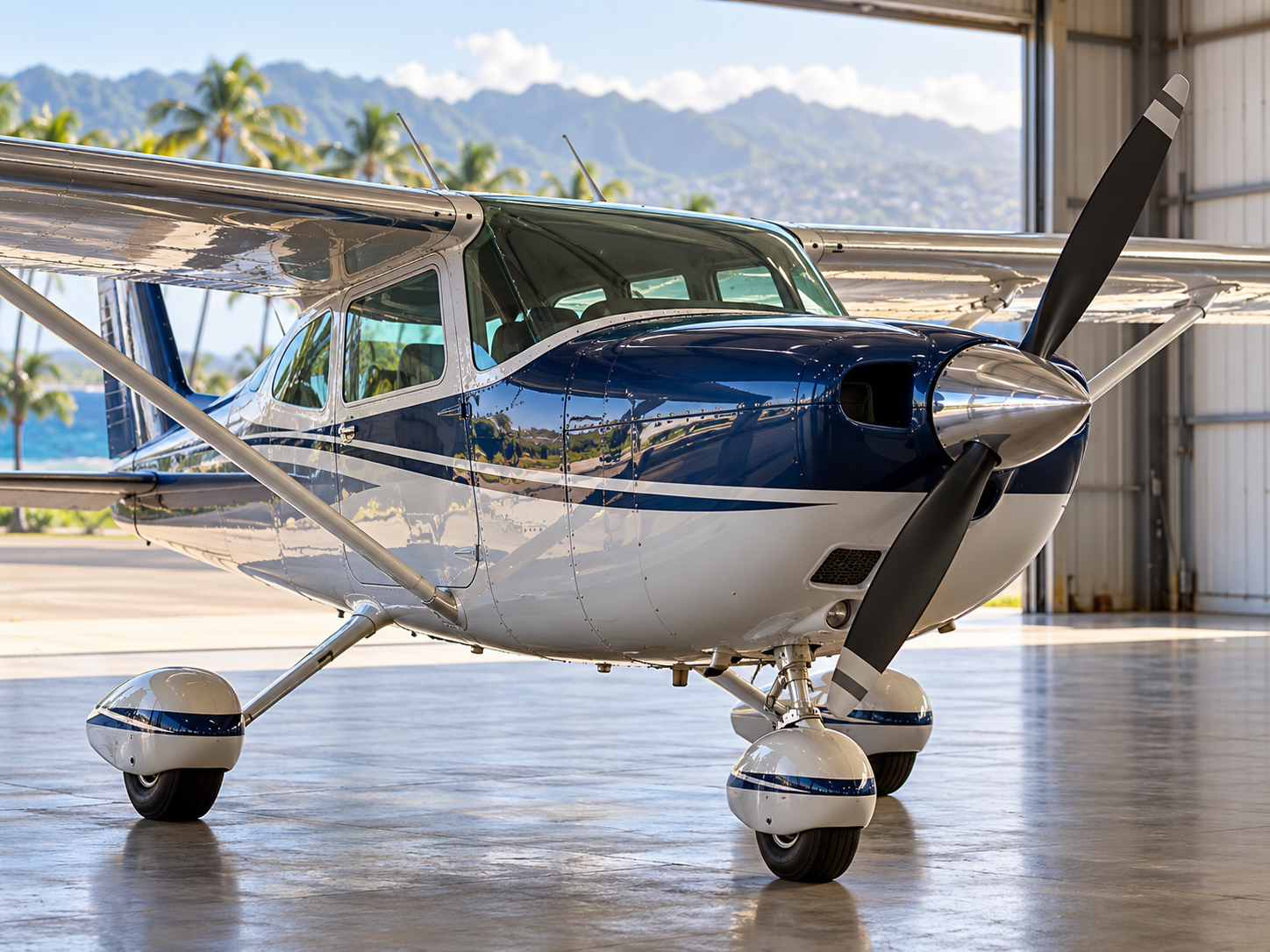
Salt, vog and sun. Your airframe sits in all three.
Interior and exterior detailing and permanent ceramic coating for aircraft and helicopters. Borograph goes on with no primer, no solvent flash and no cure oven — so we work in your hangar or on the ramp. Coating priced by the linear foot; detailing and prep by the hour.
Hangar or ramp
No primer, no cure oven
Fully insured — COI on request
Fixed wing & rotary
Visual proof
Soot off, corrosion caught early
On an airframe the cosmetic job and the corrosion job are the same job. Exhaust soot holds moisture against aluminium and salt air does the rest, so what looks like a dirty belly is usually the first stage of something you would rather catch now. Acrylic is the one surface where the wrong product is worse than leaving it alone.
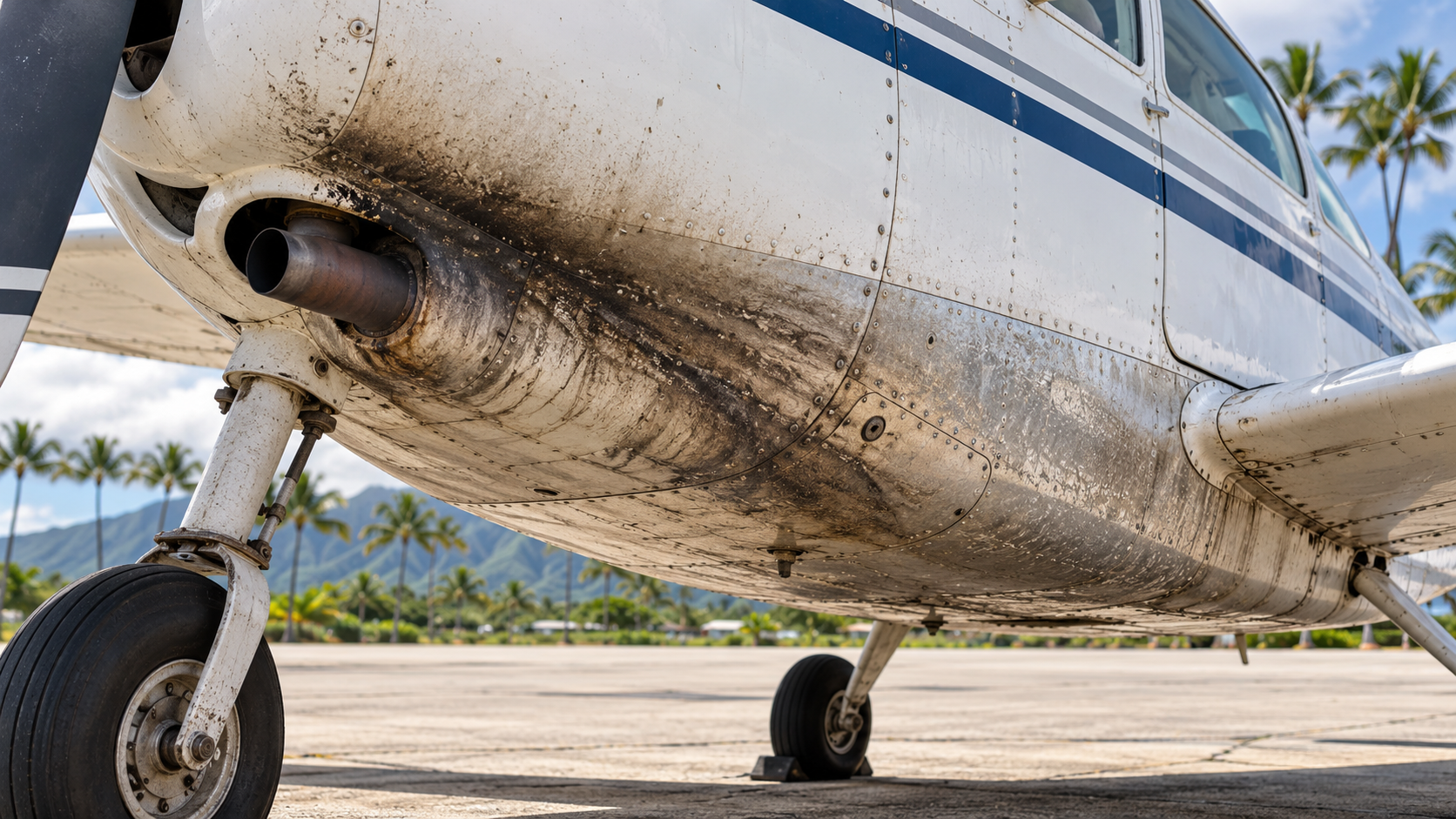
Before — soot holds moisture against the metal
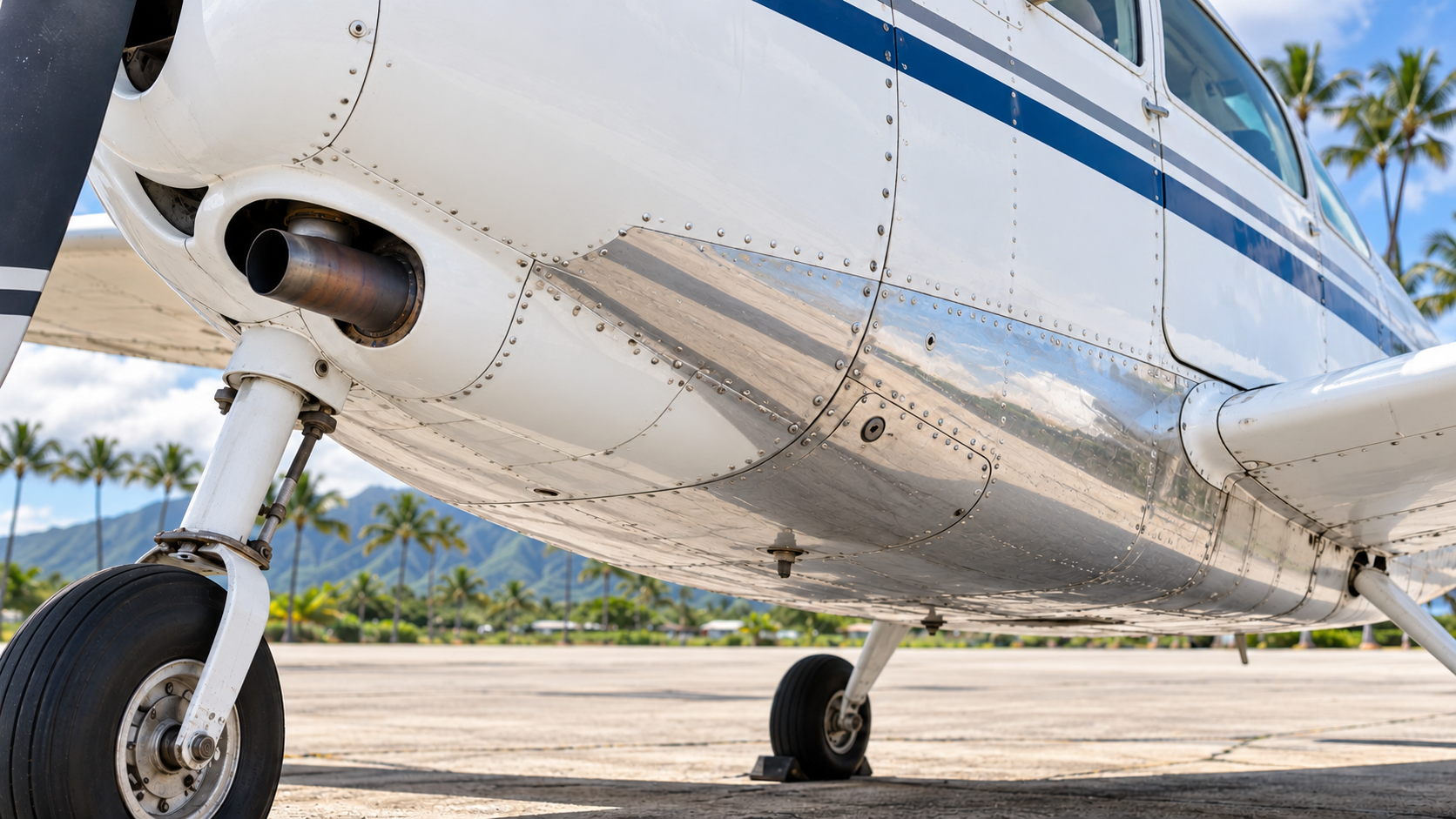
After — and now you can actually inspect the skin
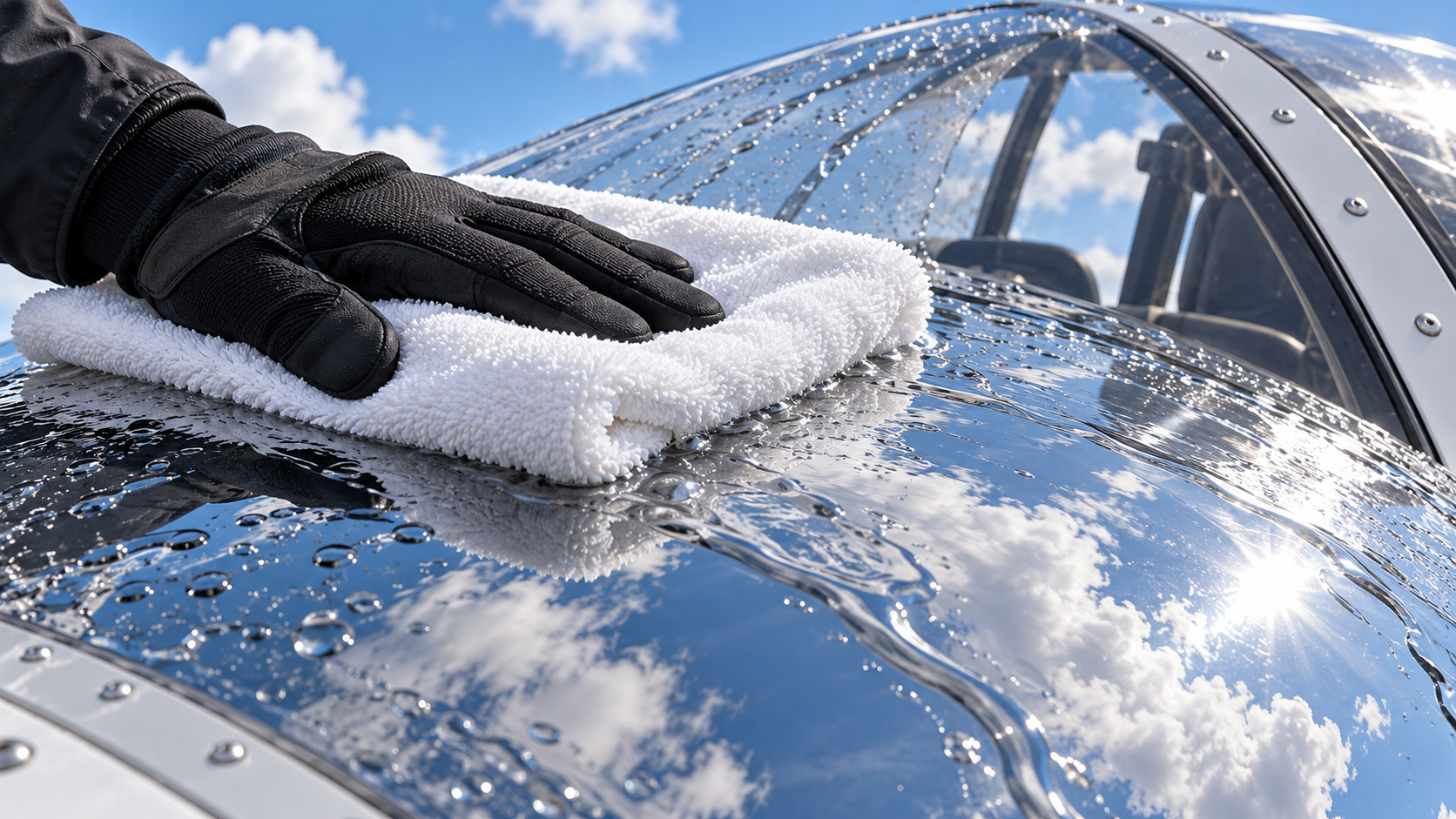
Flooded, straight strokes, plastic-safe only
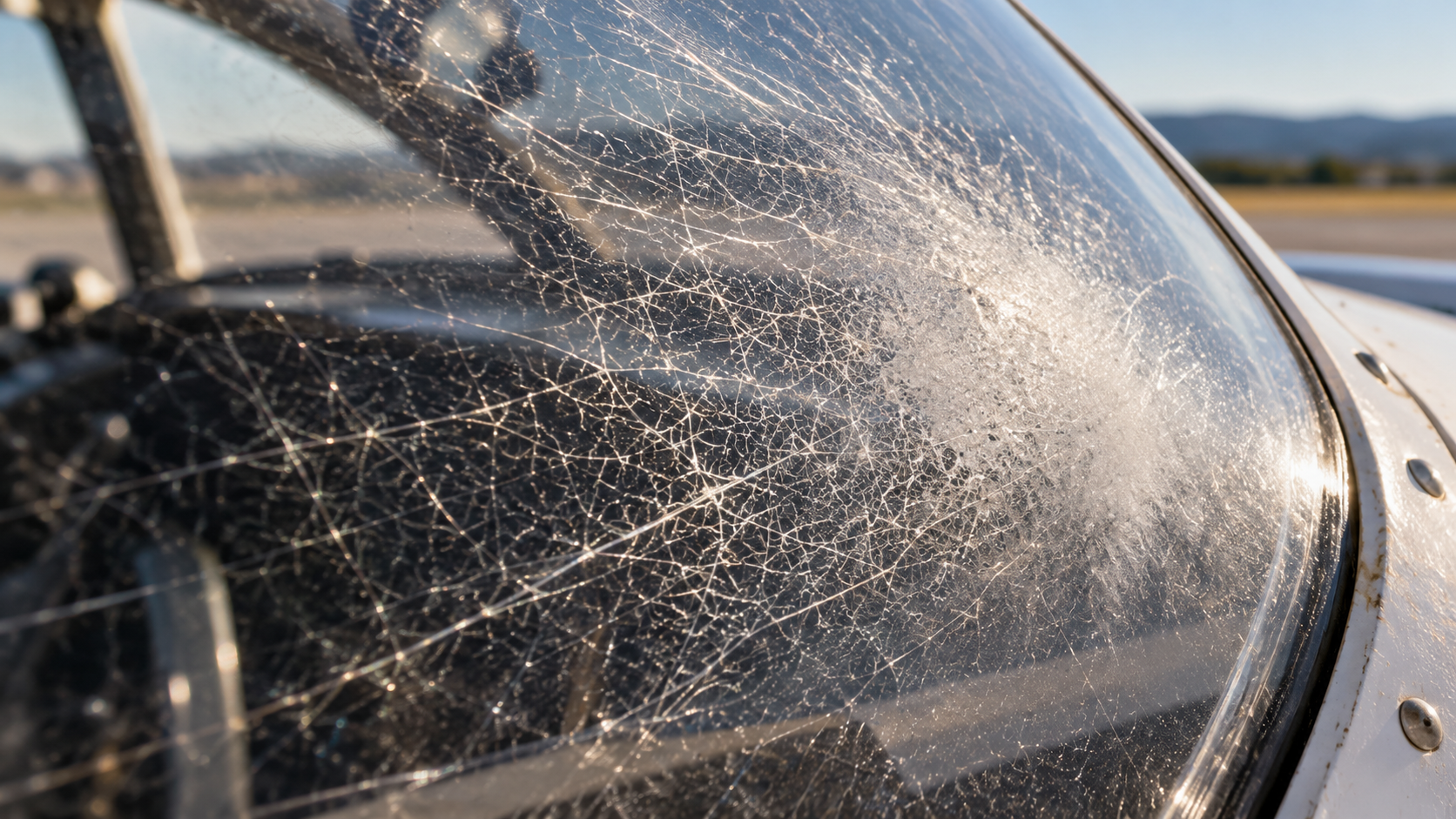
Crazing is a shop item — polishing it only makes it worse
Fixed wing & rotary
What we do
Exterior wash & decon
Belly cleaning
Brightwork & leading edges
Interior detailing
Paint prep & correction
Permanent ceramic coating
Liquid PPF + Borograph
Helicopters — fuselage only
Helicopters are fuselage only. Rotor blades are not coated, full stop. There is no price for it on this page because we do not do it.
Included in every coating price
- Wash and decontamination
- Tar and sap removal
- Surface prep wipe-down before any coating goes down
- Panel-by-panel application and inspection
- Written warranty, registered with NanoPro
Heavy prep is billed hourly at $150 / hr$156 / hr card per technician — oxidation, exhaust staining, filiform corrosion cleanup, belly grime, old wax stripping. Quoted after inspection, before anything starts.
Stated up front
What you provide, and what we won’t touch
Aviation work goes wrong when nobody says the rules out loud. So here they are, before you call rather than after we arrive.
- You supply the soap and chemicals approved for your airframe, per your maintenance manual and FAA guidance. Different airframes have different restrictions and we will not guess on yours. We bring the coating, pads, towels, machines and water management.
- You arrange ramp or hangar access and escort. Badging, tarmac escort and hangar access are on your side. We arrive with IDs and certificates of insurance on request and work to whatever your FBO or operator requires.
- Your A&P has the final word on any product that touches the airframe. We will provide product documentation before we start and expect to be asked.
- We do not touch restricted surfaces. Pitot tubes, static ports, de-ice boots, windscreens with existing crazing, or anything your maintenance manual restricts — not without written A&P sign-off.
- Rotor blades are not coated. Ever.
Island Special · Big Island pricing
What it costs
Prices shown are cash prices. Pay by cash or check and that is what you pay. The card price is shown in grey beside every figure — slightly higher, because card processing costs us that. Nothing is added at checkout either way: both prices are on the page before you book.
Hawaii GET is added at invoice and shown as its own line, at the state maximum visible pass-on of 4.712% (4% state + 0.5% Hawaiʻi County surcharge). Prices on this page do not include it.
Coating by the linear foot. Detailing, interiors and prep by the hour.
Stealth Diamond Borograph Ceramic
FuselagePer linear foot
$100 / ft$103.50 / ft card
WingspanPer linear foot — simpler surface, half the rate
$50 / ft$51.75 / ft card
Liquid PPF + Stealth Diamond Borograph
FuselagePer linear foot
$200 / ft$207 / ft card
WingspanPer linear foot
$100 / ft$103.50 / ft card
Detailing, interiors & prep
Per technician, per hourFour-hour minimum per technician — hourly work only
$150 / hr$156 / hr card
The four-hour minimum does not stack onto a coating. If you book a coating, the per-foot price is the price. The minimum only applies to hourly work.
Hangar or ramp
COI on request
13 years on the Big Island
5,000+ vehicles
Fully insured
Trained & certified techs
100% satisfaction guaranteed
Real numbers
What that works out to
Fuselage feet times the fuselage rate, plus wingspan feet times the wingspan rate. Check our arithmetic.
Cessna 172 — 27 ft fuselage, 36 ft wingspan
Stealth Diamond Borograph27 × $100.00 + 36 × $50.00
$4,500$4,658 card
Liquid PPF + Borograph27 × $200.00 + 36 × $100.00
$9,000$9,315 card
Robinson R44 — 29 ft fuselage, rotary
Stealth Diamond BorographFuselage only — no wingspan, no rotor blades
$2,900$3,002 card
Liquid PPF + Borograph
$5,800$6,003 card
King Air 350 — 46 ft fuselage, 58 ft wingspan
Stealth Diamond Borograph
$7,500$7,763 card
Liquid PPF + Borograph
$15,000$15,525 card
Wash, decon, and tar and sap removal are already in these figures. Heavy prep, if the airframe needs it, is hourly and sits on top — quoted after inspection.
In our customers’ words
Five stars, every one
Google Reviews
Shown word for word
Another great detail from Zippy. Had both my vehicles done. Came a little early and Skyler took care of business. Highly recommend. Try the super infused. Good stuff.
Did an amazing job on my wife's car. Ceramic coating all round....Explained all details and benefits. On time and would highly recommend. For all aspects of keeping you're mode of conveyance looking pristine !!!!
No obligation
Get your aircraft quoted
Tell us the type, the fuselage length and wingspan, and where it is based. We will come back with a firm number and a list of what we will need from your side before the date.
Prefer to talk? (808) 201-6005 — call or text. Open 7 days · 6am–6pm.
Straight answers
Aircraft questions
How much does aircraft ceramic coating cost?
Coating is priced per linear foot: $100 per foot of fuselage plus $50 per foot of wingspan for Stealth Diamond Borograph, and $200 plus $100 per foot for Liquid PPF with Borograph on top.
A Cessna 172 at 27 feet of fuselage and 36 feet of wingspan works out to $4,500 for Borograph. The same aircraft with Liquid PPF underneath is $9,000.
Helicopters are fuselage only — there is no wingspan figure and rotor blades are not coated.
Why is wingspan priced at half the fuselage rate?
Because a wing is a simpler surface than a fuselage — large, flat, accessible and fast to work, where a fuselage is curved, interrupted and full of detail that has to be worked around by hand.
The rate reflects the labour honestly rather than charging one blanket number per foot and hoping it averages out. You pay more for the part that takes longer.
Is Borograph approved for use on aircraft?
Yes. Borograph is an FAA-friendly coating — no primer, no solvent flash and no cure oven, so it goes on in your hangar or on the ramp without any of the infrastructure a paint process needs.
That said, your maintenance manual and your A&P have the final word on any product that touches your airframe, and we expect to be asked. We will provide product documentation before we start.
We do not touch pitot tubes, static ports, de-ice boots, windscreens with existing crazing, or any surface your maintenance manual restricts — unless your A&P signs off in writing.
What is the four-hour minimum, and does it apply to coating?
The four-hour minimum per technician applies to hourly work only — detailing, interiors and prep. It does not stack on top of a coating quoted by the foot.
Hourly work is $150 per technician per hour, four-hour minimum. That covers interior and exterior detailing, brightwork, belly cleaning and heavy paint prep.
If you book a coating, the per-foot price is the price. The minimum only comes into it if you also want hourly work on top.
What do I need to supply?
Two things: soap and chemicals approved for your airframe, and ramp or hangar access with escort.
Chemicals. You supply them, per your maintenance manual and FAA guidance. Different airframes have different restrictions and we are not going to guess on yours. We bring the coating, pads, towels, machines and water management.
Access. Badging, escort onto the tarmac and hangar access are arranged on your side. We arrive with IDs and certificates of insurance on request, and we work to whatever your FBO or operator requires.
What is included in the coating price, and what is extra?
Wash, decontamination, and tar and sap removal are included. Heavy prep is billed hourly at $150 per technician per hour.
Heavy prep means oxidation, exhaust staining, filiform corrosion cleanup, belly grime and old wax that has to be stripped before a coating can bond. On an island airframe, exhaust staining and salt deposits are usually the two that need real time.
We inspect and quote the prep before we start. No discovering work halfway through and billing for it.
Why coat an aircraft on the Big Island specifically?
Salt and vog. A parked aircraft on this island sits in marine aerosol, and when the trades are blowing it sits in what the USGS calls droplets with “the corrosive properties of dilute battery acid.”
Salt is hygroscopic, so it keeps pulling moisture out of humid air and keeps working on aluminium and fasteners long after it settled. That is the mechanism behind corrosion in places that never see standing water.
A coating gives both of them a hard surface they cannot bond to, so a wash actually removes them instead of moving them around. It also makes the airframe markedly easier to keep clean, which on a working aircraft is most of the value.
Island Special · Big Island pricing
We take one coating a day
(808) 201-6005Kona, Waimea-Kohala, Hilo and private strips islandwide. Book your spot.